China's hydrogen-powered drone breaks the one-hour endurance barrier.
26/12/2025
On April 8, 2025, the 50-kilogram hydrogen-powered unmanned aerial vehicle jointly developed by China Aviation Industry Corporation and Tsinghua University completed a continuous 30-hour cross-day-and-night flight in Chengdu Qingyang Aviation New City. This achievement not only set a new endurance record for similar domestic aircraft but also, with its internationally leading technical specifications, provided a Chinese solution for the global development of low-altitude economy and green aviation. Behind this breakthrough lies China's systematic innovations in areas such as hydrogen fuel cells, low-temperature start-up technology, 5G communications, and optoelectronic payloads, marking the country's leap from following to leading in the new energy aviation race.
I. Technological Breakthroughs: Three Core Innovations from Laboratory to Practical Application
The Disruptive Revolution of Hydrogen Fuel Cells
The hydrogen fuel cell system equipped on this drone adopts an integrated design of flight, engine, and control, limiting the fluctuation of fuel cell output power to % (the international standard is %), ensuring stable flight even in extreme weather conditions such as heavy storms. The core breakthrough lies in replacing expensive platinum with silicon-based catalysts, reducing the cost of the fuel cell from yuan per kilowatt to yuan, laying the foundation for large-scale applications. Additionally, the metal plate air-cooled fuel cell stack developed by the team achieves an energy density of .% (mass hydrogen storage density), which is times that of traditional lithium batteries. A hydrogen storage system the size of a briefcase can support hours of continuous flight.
Reliability verification under extreme environments.
At an altitude of 5,500 meters on the Qinghai-Tibet Plateau, the drone underwent a rigorous test in an ultra-low temperature environment of -40℃. Utilizing nano-aerogel thermal insulation technology (Ice Armor Hydrogen Storage), the liquid hydrogen evaporation rate was reduced to one-fifth of similar products in Europe and America, successfully solving the global challenge of low-temperature startup for fuel cells. Test data show that the system can achieve successful ignition at once and operate continuously for 30 hours in a plateau environment of -20℃, verifying its applicability in complex scenarios such as polar regions and high-altitude areas.
Land-Air Coordination and Intelligent Sensing System
Innovatively adopting the autonomous deployment technology of unmanned ground vehicles, it achieves coordinated land-air operations between unmanned ground vehicles and drones, completing takeoff and landing demonstrations under non-standard runway conditions, providing a flexible solution for field emergency deployment. Equipped with a 360-million-pixel multispectral camera and a thermal imager, it can clearly identify targets 30 kilometers away at night. Coupled with a 5G onboard module, it transmits inspection data in real-time to a command center 2,000 kilometers away, with precision reaching centimeter-level.
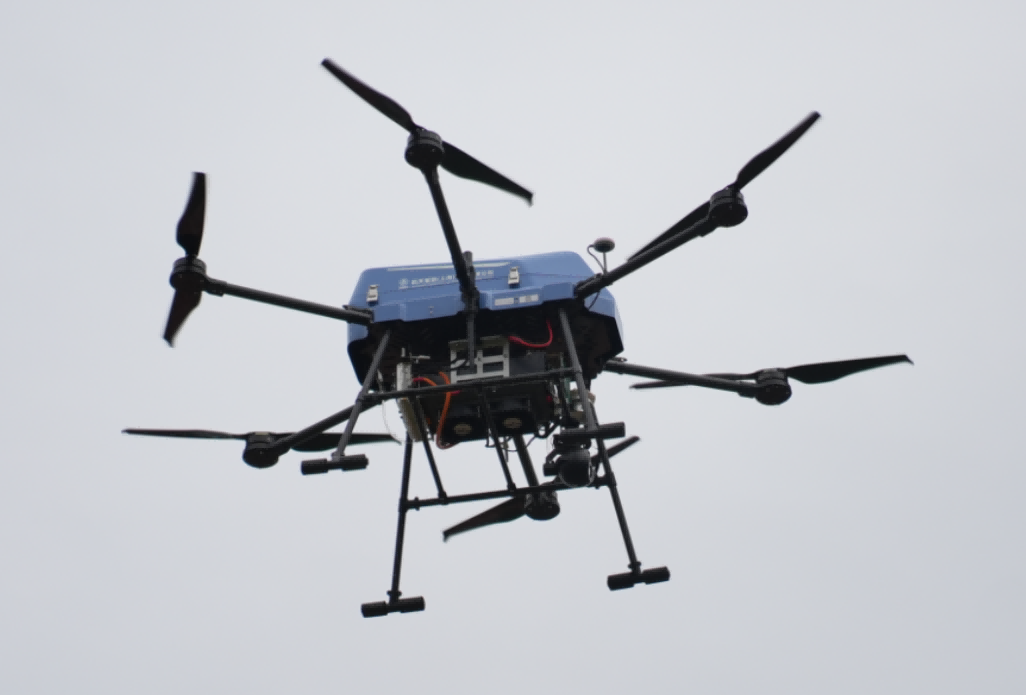
II. Application Scenarios: Multi-Dimensional Empowerment from Emergency Disaster Relief to Smart Agriculture
Emergency Rescue: Reconstructing the Golden Rescue Timeline
The drone's payload capacity of several kilograms enables the delivery of medical supplies, lifesaving equipment, and more. During the Henan floods in 2021, similar models successfully rescued 89 trapped individuals. With an endurance of several hours, it can cover the entire South China Sea. Equipped with high-precision electro-optical payloads, it is capable of tracking aircraft carrier movements. Its cost is only 1/20 that of the U.S. military's MQ-9 drone, offering a cost-effective solution for maritime emergency response.
Smart Agriculture: Solving the Labor Shortage Dilemma
At the Yunnan coffee plantation base, hydrogen-powered drones cover an area of up to acres per single mission, with pesticide utilization efficiency increasing by % and costs decreasing by %. This effectively addresses the shortage of agricultural labor in mountainous regions. Their long-endurance capability supports cross-regional farmland monitoring, enabling precise pest and disease identification through algorithms and driving the transformation of agricultural production toward intelligence and intensification.
Energy and Infrastructure: Pioneering a New Paradigm for Low-Altitude Inspection
In the inspection of offshore oil and gas pipelines conducted in collaboration with CNOOC, a single flight can cover kilometers of sea area, improving efficiency by several times compared to traditional manual inspections. In the field of power line inspection, the infrared thermal imaging camera mounted on drones can monitor temperature anomalies of transmission lines in real time. Combined with the transmitted data, this enables fault location accuracy to improve from the hundred-meter level to the centimeter level.
Urban Governance: Building a Low-Altitude Digital Twin Network
Cities such as Chengdu and Shenzhen have initiated the construction of hydrogen-powered drone logistics corridors. Pilot data from SF Express shows that hydrogen-powered models can achieve an average daily flight duration of up to 14 hours, which is 3.2 times that of lithium battery drones. In the future, it is expected to achieve a direct logistics route from Hangzhou to Wuhan within 5 hours. Additionally, the LiDAR and three-dimensional wind field monitoring systems equipped on drones can construct urban low-altitude digital models, providing real-time data support for smart city management.
Milestone in Green Aviation
The zero-carbon emission characteristic of hydrogen fuel cells makes them an ideal substitute for traditional aviation fuel. Taking this unmanned aerial vehicle as an example, its carbon emission reduction during 30 hours of flight is equivalent to planting 1,200 mature trees, providing a feasible pathway for decarbonizing the global aviation industry. With the improvement of China's network of 350 hydrogen refueling stations, the unmanned aerial vehicle can achieve a rapid 12-hour cycle of flight-refueling-flight, while the United States currently has only 47 hydrogen refueling stations, indicating a significant gap.
A New Track for Global Competition
This breakthrough directly rewrites the 24-hour endurance record held by the American Global Observer drone, marking China's comprehensive leadership in the field of long-endurance unmanned aerial vehicles. The International Energy Agency (IEA) report indicates that China's hydrogen-powered drone technology has reached a commercialization tipping point, with the global market size expected to exceed 500 billion US dollars by 2030, and China is projected to capture over 30% of the market share.